


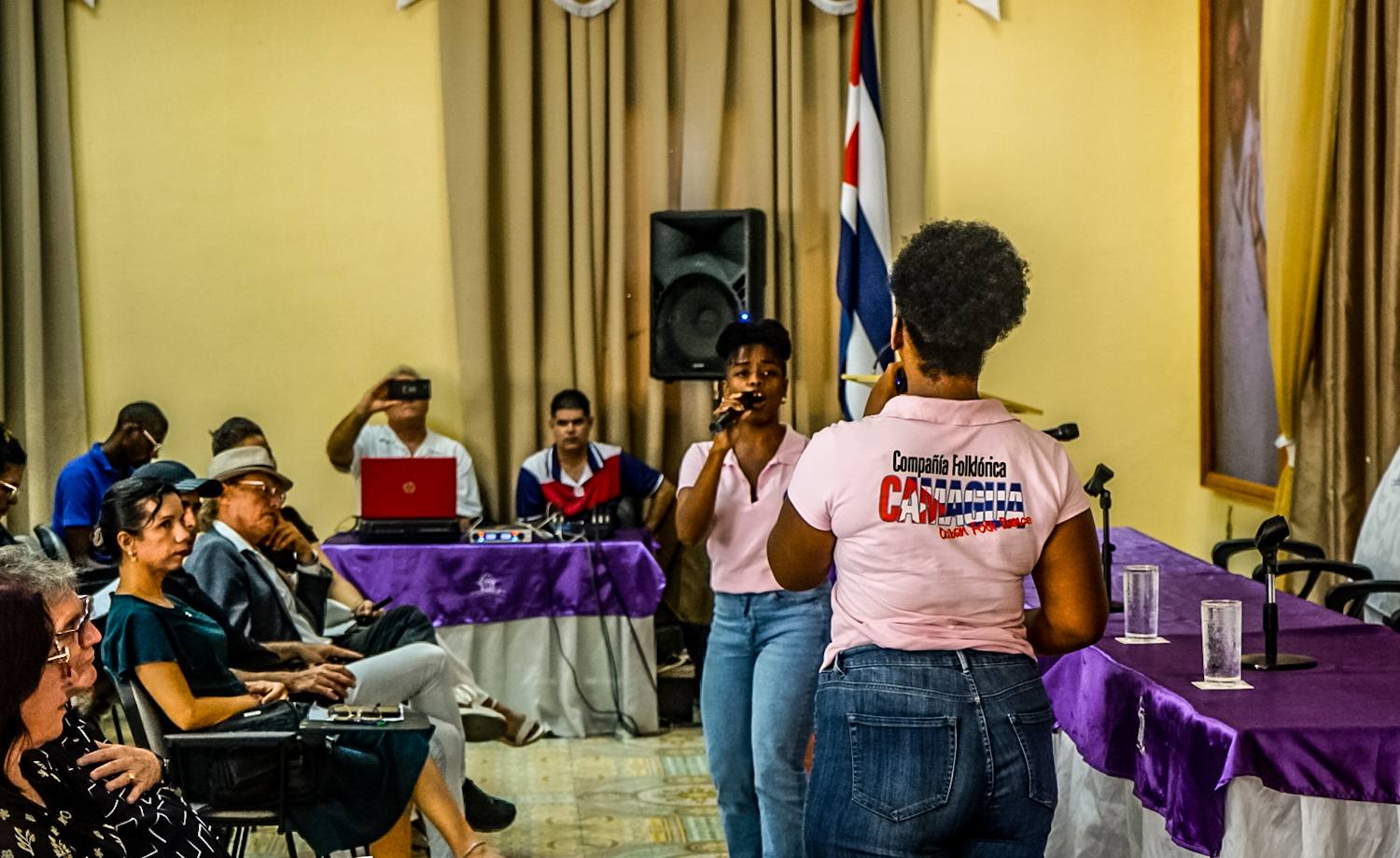
CAMAGÜEY. Among the excerpts the Camagua Folkloric Company will perform this Saturday, April 11th, at the Avellaneda Theater is Chancleteando. Today, part of the group’s established repertoire, the piece also serves as a symbolic bridge to an unexpected image: a young Fernando Medrano dancing. For decades, Medrano has been publicly defined by his leadership—the director, the researcher, the guide—rather than the performer. And yet, a photograph shared during the recent theoretical session returns him to that origin: a teenager, still in secondary school, performing the very dance of the chancleta.
That discovery, revealed in the biographical research presented by Mayloisi Mejía, does more than humanize the director. It helps illuminate the deep continuity of a body of work rooted not in abstraction, but in lived experience. From his early involvement in amateur groups, through his time with the Siboney ensemble, to the founding of Maraguán at the University of Camagüey, a trajectory emerges in which practice precedes theory. Even his training as an engineer appears secondary to a vocation that not only endured, but expanded—ultimately taking shape in Camagua in 2011, the space where, as he himself has acknowledged, his artistic vision fully crystallized.
The theoretical event marking the company’s 15th anniversary, held at the Santa Cecilia Convention Center, underscored precisely that: the articulation of memory, analysis, and projection. From Armando Pérez Padrón’s intervention, which placed Camagua within a broader tradition of folkloric studies in Cuba—recalling audiovisual records as early as 1949 featuring Celina González—to Kenny Ortigas’ reflections defending the group’s aesthetic and anthropological depth against reductive readings, a central idea took shape: Camagua is not just performance—it is the result.
The result of sustained research in folkloric communities, as highlighted by Heidy Cepero Recoder, who emphasized Medrano’s commitment to learning from the natural contexts of tradition before bringing them to the stage. The result, too, of a work ethic grounded in technical excellence without losing cultural depth. And ultimately, the result of a vision capable of engaging diverse audiences, both in Cuba and abroad.
The messages shared throughout the event—many of them also circulated on social media—confirmed Camagua’s reach beyond its usual stages. Voices such as Johannes García, who recognized in Medrano the creation of a new aesthetic in folkloric performance without losing its essence, and singer Yaíma Sáez, who recalled her experience performing La mazucamba with the group, offered perspectives that converged on a single point: the rigor and authenticity of a body of work that has earned both respect and admiration. They join a broader chorus of artists and scholars who, from different contexts, validate a path built on research, performance, and cultural commitment.
Toward the close of the session, Medrano made a gesture that transcends the stage and enters the realm of cultural memory: the donation of company artifacts to the Ignacio Agramonte Provincial Museum. More than material objects—a Cuban robe, a guayabera, programs, invitations, festival posters, and a plaque from a European tour—they are fragments of an ongoing history now placed under institutional care. The act carries a clear statement: artistic work does not end with applause; it must be preserved, documented, and shared as part of collective heritage.
In this sense, the documentary Camagua Folk Dance: The Steps of a Festival, presented during the session, becomes essential. Not only does it document the five editions of the event organized by the company—from its virtual version during the pandemic to its in-person consolidation—but it also stands as tangible evidence of a broader intention: to record, to leave a trace, to build memory. In a field like dance, where the ephemeral often prevails, such an effort holds particular significance. To document is also to legitimize.
This connects directly with one of the day’s most revealing ideas: Medrano’s dream. Beyond sustaining the Camagua Folk Dance festival—already successful in bringing together dance pairs from different countries—lies the ambition to elevate it into a full-scale international festival of folkloric ensembles. As expressed in the documentary, the aspiration does not seem excessive when viewed against the company’s trajectory. Rather, it appears as the logical extension of 45 years dedicated to directing, teaching, and creating.
What this anniversary ultimately made clear is that recognition—national and international—is no accident. It is the visible expression of accumulated work, of a coherence sustained over time, and of a rare ability to integrate practice, research, and stage projection into a single artistic gesture.
In that light, Chancleteando becomes more than a performance excerpt—it becomes a metaphor: of the journey from a young dancer to an established director; of a bodily memory transformed into stage poetics; and of a body of work that, in looking back, finds the keys to projecting itself forward. It is in that balance between past, present, and aspiration that Camagua’s true dimension resides.
Translated by Linet Acuña Quilez