


CAMAGÜEY.—At the Biblioteca Provincial Julio Antonio Mella, during Camagüey’s Culture Week, a panel marked the 95th anniversary of the birth of Jaime Sarusky. For me, speaking about someone I barely knew, yet who left a profound imprint, always stirs a mixture of gratitude and tremor.
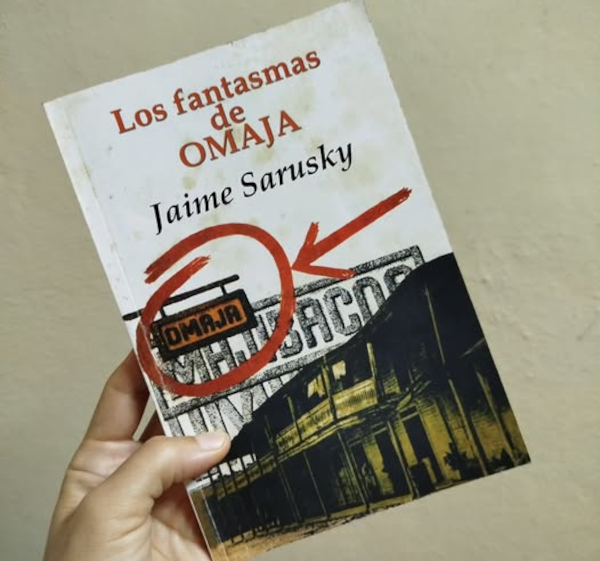
I met Sarusky at the 2011 Book Fair. He was 80. I was 26. More than half a century stood between us, yet it took only an instant for that abyss to become a bridge. I bought his book Los fantasmas de Omaja (The Ghosts of Omaja) and had the good fortune of receiving a dedication: “a good course in journalism.”
The panel revisited both his work and his ethics. Jorge Santos recalled how Sarusky dedicated Los fantasmas de Omaja to him in gratitude for being the first to review Rebelión en la octava casa in the newspaper Adelante, and mentioned his collaboration on a forthcoming critical volume about Sarusky’s work. Damaris Hernández highlighted his cultural journalism and the way he erased boundaries between genres, blending investigative rigor with literary sensitivity.
The Provincial Library’s holdings include several of Sarusky’s books, in both the general and literature collections, allowing readers and students to approach his work directly and explore the stories through which he portrayed a diverse Cuba with precision and empathy.
Los fantasmas de Omaja is an emotional map of Cuba, composed of five reportages originally published in Bohemia magazine between 1971 and 1983. The edition I own was released by Ediciones Unión in 2010. Its brief foreword, signed by Manuel Moreno Fraginals in Havana in February 1984, calls them chronicles. I prefer to say narrative reportages: born of investigative rigor, yet written with the breath of literature. Today, the book can be read as a living masterclass in investigative journalism—how to ask, how to observe, how to listen, how to turn data into humanity.
Sarusky traced migrations, communities, and invisible footprints that shaped Cuban identity: Americans in Las Tunas, Swedes in Oriente, Japanese on the Isle of Youth, Indians in Guantánamo, Yucatecans in the expansion of the sugar industry. Each story is a ghost inhabiting the nation—a portrait of people who arrived from afar and transformed what we now call Cuba.
In an interview with La Jiribilla, he confessed that he never expected the book to return more than twenty-five years after its first edition. He thought it had been left behind. But he understood something essential: a country with a culture of knowledge can return to its books.
That return is not nostalgia. It is a persistent question: who are we? The migrations Sarusky traced are not past—they are invisible layers of Cuban identity.
In that same interview, he offered simple, radical advice: write every day. Even two lines. Even without inspiration. For him, each line was a commitment to society. He did not speak of fame; he spoke of responsibility.
Sarusky believed the journalist and the writer are inevitably intertwined. He would grow uneasy if one line did not converse with the one before and the one after. Journalism provided the data, investigation, and context; literature offered psychology, conflict, and emotion.
After reading these reportages, I feel, first, a healthy envy for a time in journalism when mobility was possible, when reporters could leave the asphalt behind. It was another newsroom culture, another conception of the craft. I also feel gratitude toward those who came before us. Through what they achieved, they hold up a mirror and ask how far we still have to go.
The subjects Sarusky addressed speak of a Cuba difficult to imagine today: Cuba as a land of opportunity. Now Cubans leave. And that desperation to anchor oneself somewhere recalls those immigrants who once arrived from India, Japan, Sweden, the United States, or Mexico.
Perhaps we remain, at heart, that ever-thickening ajiaco—a stew we have reduced to three ingredients: Taíno, Spanish, and African. Los fantasmas de Omaja insists we are far more. And that the question—what does it mean to be Cuban?—remains unanswered.
It is especially valuable that Sarusky gave faces to other roots that also endured dispossession, exploitation, and uprooting in Cuba. Today, when slavery and historical suffering are discussed, the narrative rightly centers on the tragedy of enslaved Africans and their descendants. That wound is structural and cannot be relativized.
But Sarusky showed, decades ago, that the history of suffering in Cuba was not monotone. Others endured coercive labor systems, forced displacements, deception, and exploitation. His gesture does not compete with one memory against another; it enlarges memory. And in that enlargement, there is justice.
When bidding him farewell, Fernando Martínez Heredia wrote words that still ache: “I do not fear death. I fear that our time—the one that produced Jaime Sarusky—will die.” And yet he held onto hope that others would come, capable of creating a higher time. Perhaps that is why we keep returning to him.
Reinaldo Cedeño once recounted how Sarusky stopped him in a hallway to say: “Write books… write books.” It was more than a phrase; it was an ethic. A way of urging others not to let time die.
I never walked hallways with him. But I keep his dedication, his book, and the memory of a day when a voice told me—without knowing it—that this path was also possible. Perhaps that is what it means to speak of someone absent: not what he was, but what he still provokes.
And as long as someone continues tracing ghosts, Jaime Sarusky will not be dead.
Translated by Linet Acuña Quilez