


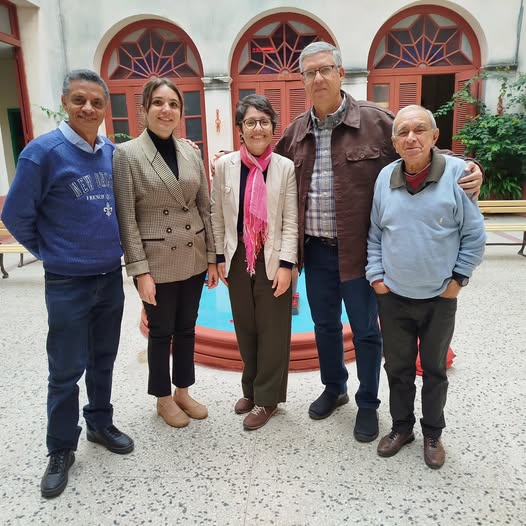
CAMAGÜEY.—At times, it felt as if the entrance to the Julio Antonio Mella Provincial Library was no longer in Camagüey but at a crossroads of centuries: ancient Greece, nineteenth-century Cuba, Dickens’s Europe, Eva Perón’s Argentina, Gaitán’s Colombia. As Félix Julio Alfonso López spoke, time seemed to open like a fan.
He is not from Camagüey. Born in Santa Clara in 1972, he has lived in Havana for years and holds a PhD in Historical Sciences from the University of Havana. Yet at the Camagüey Writers’ Meeting, one thing was clear: some forms of belonging are not determined by birth certificates, but by the gaze. Camagüey, too, is his.
Félix Julio did not arrive as a perfunctory guest. He arrived as someone returning. In 2023, he had already dedicated a book to this city—The Dagger in the Chest: Political Imaginaries and Anti-Colonial Rebellion in Puerto Príncipe (1848–1853), winner of the Historical Criticism Award. This time, he brought The Banquet of the Muses, available only in digital format, and left copies for everyone at the Library, like an offering.
He said this was his second Camagüey book—not because of its subject, but because of its cover: a work by painter Joel Besmar. He discovered Besmar last year while walking along Maceo Street, where an open-air gallery displays reproductions. Among them, what caught his eye were shelves of old books placed in “borderline situations.” He asked about the artist. He found him. And Besmar agreed to provide a piece for the cover. “That artwork turns the book, as a physical object, into something truly beautiful,” he emphasized.
It was no minor detail. On social media, Félix Julio describes himself as “passionate about History and Beauty.” That is the key to everything he does.
The Banquet of the Muses (Arte y Literatura, 2025) grows out of a long-standing obsession: how historians write History. To explain it, he returned to the origins—Herodotus, Thucydides, Aristotle, Homer—recalling that since classical Greece, there has been debate over whether History is science, narrative, or poetry. He then brought Hayden White onto the scene, the American critic who in the 1970s shook the discipline by arguing that History and literature share the same raw material: language.
“Historians are a particular kind of storytellers,” he said. “And our narratives meet many of the requirements of fiction, even though they are bound by plausibility.” Tropes, metaphors, and narrative structures—all are there.
Through that “side door,” he arrived at the historical novel—not as a minor genre, but as a territory where History is destabilized and retold. In his book, Dickens, Orwell, Tomás Eloy Martínez, and Juan Gabriel Vásquez enter into dialogue. Bodies that do not rest: Eva Perón, Jorge Eliécer Gaitán. Figures who, even after death, continue to unsettle the living. “Reality and fiction,” he said, “desperately seek each other.”
Félix Julio spoke without solemnity but with fierce honesty: “Pure objectivity in History is impossible.”
The past does not repeat itself; it is besieged by the present. Every historian arrives with a sensibility, an ideology, a toolbox. From the same “pure” event emerge “impure” versions. Everything ultimately ends on the blank page: “Historians should feel the same terror a novelist feels before a blank sheet.”
He defines himself as a “Flaubertian” historian—obsessed with the exact word, with the sentence that aims not at truth but at verisimilitude. That is why he urges his colleagues to read a great deal of literature—not only to write better, but to think better.
The book’s foreword is by Julio Travieso, one of Cuba’s great novelists. Félix Julio spoke of their friendship, their conversations, the defeats and victories of writing historical fiction. He recalled Travieso’s life—marked by clandestine activity, prison, violence—and how, with Dust and Gold, he fused History and fiction into a grand fable.
“When a novelist approaches fiction from fiction, they only have to prove their creativity,” he insisted. “But when they approach it from History, they enter a far more demanding realm.”
That Félix Julio discovered Joel Besmar while walking along Maceo Street, that he conceived this book from Camagüey, that he returned to share it and leave it in the Library, is no coincidence. Camagüey is not merely an object of study for him; it is a space of revelation.
A few days ago, as he spoke, it seemed he was not only presenting a book, but defending a way of understanding History—not as a dead archive, but as a living narrative, crossed by beauty, doubt, and imagination.
Perhaps that is why the title: The Banquet of the Muses. Because, in the end, every historian also listens—whether or not they admit it—to that ancient whisper that comes from art.
Translated by Linet Acuña Quilez