


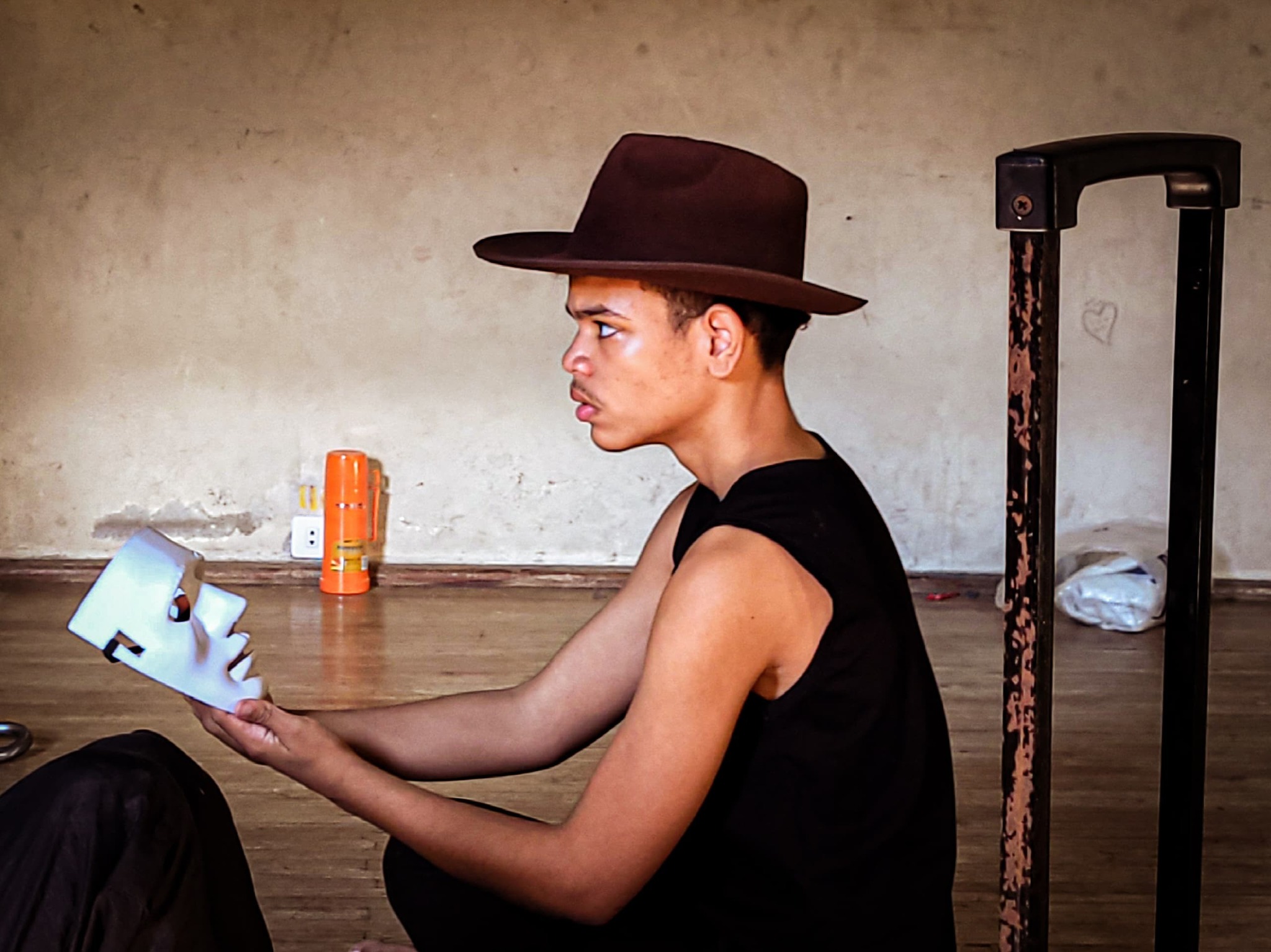
CAMAGÜEY.—I walked into a rehearsal of The Weight of an Island three days before its premiere. The Avellaneda Theater had no electricity. The stage was held together by the faint daylight filtering in from one side and a few scattered flashlights that carved moving bodies out of the darkness. There was no lighting design yet—though Freddys Núñez Estenoz’s was already on paper—but there was something more essential: theater stripped to its core, where gesture, word, and breath are enough.
In that improvised half-light, something else was revealed as well: the sustained work of Leonardo Leyva as both director and pedagogue. The Weight of an Island, performed by third-year Acting students from the Vicentina de la Torre Academy of the Arts, is not merely the main premiere of the Villanueva Theater Festival in Camagüey. It is the result of a training process that grows sharper, more demanding, and more self-aware with each passing year and each new production. Conceived as part of the course Theater in Verse, the piece is deeply rooted in the best traditions of Cuban theater and poetry, drawing primarily from Perla marina by Abilio Estévez.
With staging and dramaturgy by Leyva, the production will be performed on January 23rd, 24th, 25th, 29th, 30th, and 31st at 9:00 p.m. at the Avellaneda Theater. It offers a symbolic exploration of Cuba’s insular condition and the processes through which national identity is shaped. Rather than unfolding through a linear historical narrative, the work is built from images, actions, and situations that evoke the birth of the island, its cultural diversity, its internal tensions, and its permanent dialogue with the sea—as both border and horizon. Through music, poetry, and physical performance, the young actors create a universe where geography, memory, and imagination converge to shape the Cuban experience.
For this reason, the production avoids shouting or excess. Leyva has chosen a different path: restraint, precision, almost the tone of a requiem. Not to deny pain, but to avoid repeating it in a trivial way. “There are already too many anxieties, farewells, departures,” he says—and that intention is palpable onstage: a desire to transform the wound into song, image, and essential gesture.
Leyva approaches this work as a territory of risk. Speaking about Cuba, he has noted, requires care—especially when those doing the speaking are adolescents living, in real time, the country’s fragilities, separations, and uncertainties. Training here is not limited to learning how to act; it also involves recognizing oneself within a complex Cuban identity, shaped by suffering but also by poetry, music, and cultural memory.
The production is structured around a gallery of symbolic characters—Filemón Uztariz, Tato the Joyful, Ñico the Irreverent, Mercedes the Defiant, the Virgin of Charity of El Cobre, the Queen, Cassandra the Blind, and Juana the Naïve—each embodying different realms of thought, spirituality, humor, dissent, and human vulnerability within the island’s landscape. Together, they form fragments of a collective psychology, an identity oscillating between the desire to leave and the impossibility of fully letting go.
The students are not portraying an anecdotal or realistic Cuba. They are traversing a symbolic one, woven from texts, music, and shards of cultural memory: Fornaris, Gertrudis Gómez de Avellaneda, José Martí, Christopher Columbus’s diary, Luis Carbonell, Celia Cruz, Guantanamera. These are not decorative references, but threads that connect the performers to a sense of Cubanness many of them had not previously known—and now must embody. Here, training extends beyond acting technique into a pedagogy of recognition: learning to love what one is, even when it hurts.
The dramaturgical foundation—Perla marina by Abilio Estévez—deepens this trajectory. It is not a play driven by dramatic progression or classical conflict, but a constellation of voices, states, and figures that do not move toward resolution, instead dissolving—much like the Cuban experience itself often dissolves into a state of perpetual waiting. Estévez once said that this is not a play, but an act of faith. Leyva embraces that idea and carries it into the classroom, the rehearsal room, and the stage: working with these young performers, in this context, is also an act of faith.
The stage symbolism—the paper boat, the suitcases, the sea, the parasol shielding bodies from an oppressive sun, the white mask passed from one body to another—does not illustrate; it condenses. These are signs that evoke childhood, travel, exposure, identity as both play and trap. In the students’ hands, these objects become tools for self-reflection, for probing a collective psychology in which each character represents a facet of the same insular body.
Perhaps what is most revealing, however, lies not only in what is seen, but in how the work is made. Leyva insists that he does not direct actors; he directs students. And in that blurred boundary between teacher and director, something uncommon takes place. The goal is not to fulfill a syllabus or to mount a “correct” production, but to open a space of transgression—where young people can confront a form of theater that offers no easy answers, and a country that offers none either.
Premiering within the framework of the Villanueva Festival is no minor detail. It places these bodies in training at the center of a foundational moment in Cuban theater history. In a context marked by scarcity, illness, closures, and material hardship, what sustains the process is not infrastructure, but rigor and passion. “Doctors are trained in hospitals,” Leyva says. Actors, in front of an audience.
What I witnessed during an hour-long rehearsal was not a simple academic exercise. It was a group of adolescents confronting, with rigor and sensitivity, a complex subject: the island as wound, as memory, and as destiny.
The Weight of an Island does not attempt to define what Cuba is. It does something more honest—and more difficult: it creates a space where that question can breathe, ache, and sing through young bodies that carry, perhaps without fully realizing it, the weight—and also the beauty—of an entire island.
Translated by Linet Acuña Quilez