
CAMAGÜEY.— I had seen Tatiana Morales Rodríguez around. I knew about the Russian woman who has lived in Camagüey for more than four decades, but I had never actually spoken with her. Just a few minutes before the Book Fair press conference was due to begin, we finally had the chance to talk briefly.
Later, I heard her read Pushkin in Russian.
It was a beautiful scene: her voice seemed to return to that language a memory that had traveled from Kryvyi Rih to Camagüey and, so many years later, had still found a place here where it could dream.
That was when I learned something else: Tatiana writes, too. And she writes for children.
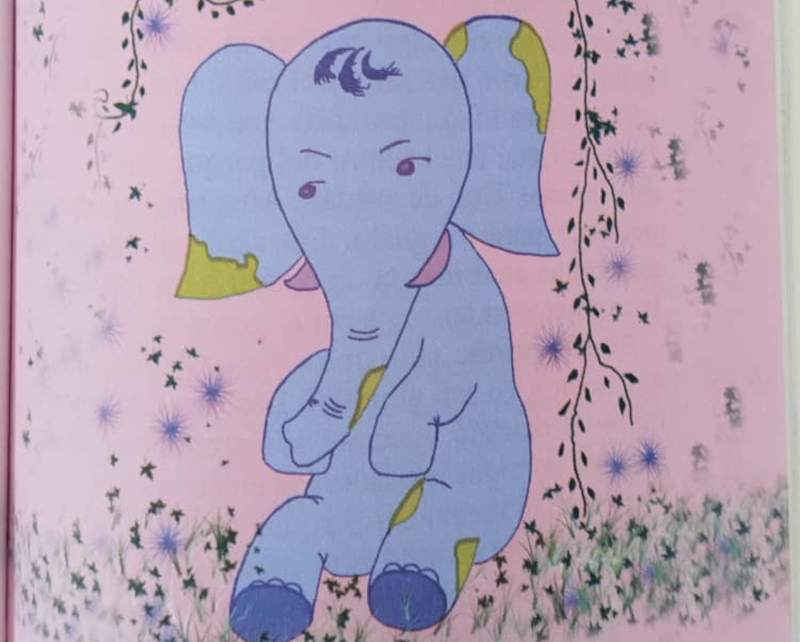
Stories for My Child, lent to me by one of her friends, came into my hands soon afterward. Published by Editorial Oriente in 2011 as part of the Ala y Espuela collection, the book contains 18 stories across 70 pages. Tatiana wrote the texts and created the illustrations herself.
I read it hoping to get to know better the woman I had heard reciting Pushkin. Instead, I found something else: her way of seeing.
The opening story, The Adventures of Time, reads almost like a statement of principles. “Time draws the passerby in…,” “Time charms the young girl…,” “Time lulls the grandfather to sleep…,” “Time plays with the child….” And when time finally catches up with her, it disguises itself as a blue elephant, rides a bicycle with the yellow wind, braids her hair with kite tails, and eventually carries her to a house filled with dreams and clouds.
That is how Tatiana writes: putting images where we would normally put explanations.
In her stories, time can play, hours can disobey, a leaf can dream of becoming an airplane, the corners of a city can argue over who gets to tell their stories, and the wind, against all evidence, can be seen. There is a pink wind that smells of butterflies.
Tatiana writes by drawing. It is no coincidence that she also created the illustrations. Her literature seems to spring from an imagination that needs to turn the invisible into something we can see, touch, smell, or taste. Because in the end, words have flavors, too.
In What Does the Sun Taste Like?, the final story, the little girl explains that every word has its own color and flavor. Dawn tastes like daisies; nightfall tastes like jasmine; play tastes like vanilla-and-strawberry ice cream; the full moon tastes like cheese and sardines. The sun, however, remains a mystery: it is so hot that she still has not been able to figure out what it tastes like because it burns her tongue.
After reading that ending, I found myself thinking that Tatiana is not trying to teach children what the world is like. She offers them something more generous: the chance to imagine what it might be like.
But Stories for My Child does not unfold in just any childhood. Although its pages are filled with elephants in the clouds, gnomes, kites, leaves longing to fly, and mischievous clocks, a recognizable city keeps slipping into the stories.
In September, schoolbooks have to be covered. There are parks, neighborhoods, streets, and street vendors calling out their wares. There is a computer with a cold that needs an electronic doctor; a cat that gives concerts for the whole neighborhood, even though at home it does nothing but sleep; a meteorologist; houses, street corners, and neighbors.
In The Corners, perhaps one of the most unmistakably Camagüeyan stories in the collection, the city is made of stories:
“The corners of my city are full of stories; they quarrel over who gets to tell them.”
The narrator walks from one corner to another to meet them, greet them, and listen to their tales. There is a green corner, a yellow one, a blue corner steeped in nostalgia, a musical corner, a corner of proverbs, and two riddle corners that are always fighting. It is a very particular way of walking through a city: not to describe its buildings, but to listen to what they have to say.
And then there is family. Above all, the mother.
In Kite Day, while the adults argue over which day is truly Kite Day, only the mother remains silent. The little girl knows that her mother knows the Great Day—the day when all the kites, chiringas, barriletes, and cometas escaped from their owners and flew off into the countryside.
In Dreams, the mother keeps her own dreams in a carved wooden chest. On some nights she opens it, and the dreams go out to visit the houses in the neighborhood. The little girl’s friends then fall asleep hugging a smile, “and the happiest one is mine.”
There is a tenderness in these stories that does not seem designed to deliver a moral. It lives in the gaze itself. In the trust with which a mother can become an accomplice to a child’s imagination while, at the same time, allowing that child to discover the world independently.
Perhaps that is why the book also feels like a maternal gift.
I do not know when these stories were originally written. In 2011, when Editorial Oriente gathered them together in Stories for My Child, they began their public life as a book. Today, in 2026, we read them fifteen years later, after so many things have changed—in Cuba, in Camagüey, in Tatiana’s life, and, of course, in the literature we write and offer our children. Authors have ventured into new territories, finding words even for places where there were once silences or subjects too difficult to name. And yet these stories retain a strange freshness.
Perhaps it is because they speak from a place that does not belong to any particular era: imagination, tenderness, curiosity, family, that innocence which is not ignorance but a way of protecting the capacity for wonder.
What does a child need in order to grow strong? What truth do they need to know, and what must they still be allowed to imagine?
These stories suggest that we can also grow strong when someone allows us, for a while, to look at the world with eyes capable of inventing it.
Tatiana was born in Kryvyi Rih, Ukraine. She is a Russian citizen and has lived in Camagüey for more than four decades. Here, she learned the secrets of another language and another culture; she took part in literary workshops; she cultivated the décima; she illustrated; she wrote for children. Stories for My Child received the Sigifredo Álvarez Conesa Creative Fellowship in 2010, before becoming a published book with Editorial Oriente a year later.
All of that matters. But after reading the book, the label of origin matters less. Because what Tatiana is doing here is more complex than preserving an identity: she is creating another sense of belonging.
And there is something else I now want to find out by talking with her. I know that when we finally agree on a date for the interview, I will be able to sit down and talk with Tatiana. It may even happen on one of those special days she herself invented for her stories: Tuesday-Thursday, Friday-Monday, Sunday-Wednesday, Monday-Saturday, Thursday-Friday-Sunday.
Because perhaps that is another key to her integration: Tatiana did not simply learn our language; she dared to play with it, bend it, mix it, and make it her own. After more than four decades in Camagüey, that too is a beautiful way of belonging.
Back then, we listened to Tatiana in Russian. Now we can listen to her in Spanish. And we discover that when she writes, time dresses up as a blue elephant, winds have colors, words have flavors, and an entire city can fit inside its corners.
All we had to do was open the book.
Translated by Linet Acuña Quilez