
CAMAGÜEY.—Thursday was the last class of the summer. After that will come the graduation ceremony being organized by the Cuban Association of Artisan Artists in Camagüey for students from the different workshops. But before bringing this short series to a close, I wanted to pause over a discovery that perhaps was not part of the original plan: the crochet girls.
The ages have varied, and some of the girls were already working alongside their instructors in the advanced group. But this summer, what stood out was the number of girls and young women who joined, the enthusiasm with which they learned, and, above all, their desire to go beyond what they were taught.
Melany is eight years old and arrived full of energy. She crocheted quickly—so quickly that her stitches kept coming out too loose. Little by little, she learned to stop, look, and correct her work. She also discovered that hands can learn to control what sometimes seems impossible to quiet.
And then came something else: initiative.
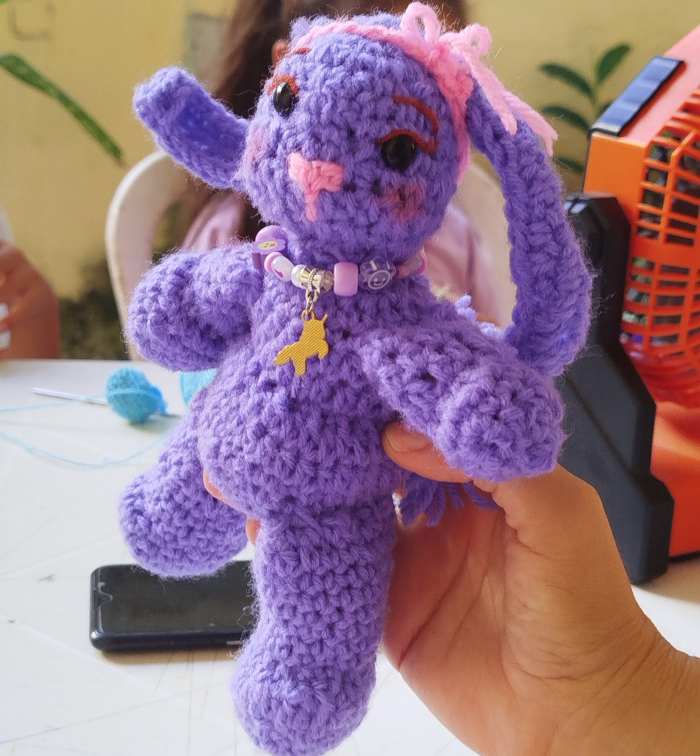
Besides the owls, phone pouches, and coasters the instructors suggested as gifts for mothers and grandmothers, Melany made a little bag for her water bottle. She has crocheted other figures as well. Today she showed up with a penguin. Before that, she had brought a little frog, another doll to which she added a pacifier that surely belonged to another toy, and, more recently, this rabbit.
Perhaps that is the most beautiful part of learning: when it stops being an assignment and becomes a possibility.
There are also those little difficulties that ultimately become lessons: when the yarn is pulled too tightly and the work turns out more compact than expected; when it breaks and you have to figure out how to join it back together; when a knot appears and forces you to stop; when you want to change colors and have to discover how to continue without losing your stitches. Every setback has something to teach.
And then there is what happens among the girls themselves. One of them comes up with an idea, and immediately another wants to try it. One changes a color, invents a shape, adds something to a figure, and suddenly the idea begins making its way around the table. Without realizing it, they are learning not only from their instructors: they watch one another, imitate one another, inspire one another, and teach one another. Perhaps that is another thing crochet has woven this summer: a small community where one girl’s idea can become another’s next experiment.
They arrived shy, some hardly daring to speak to the others. As the days went by, they broke through that initial barrier: they ask questions, talk about what they are making, look at one another’s work, praise it, and even feel confident enough to show what they have created at home. For a generation growing up increasingly surrounded by screens and with fewer opportunities for face-to-face interaction, sitting around a table, sharing a strand of yarn, and learning together is a simple way of bringing conversation back.
The girls have also taught the adults. Because teaching an adult is not the same as teaching a child. A child may tell you she still does not understand after you have explained it twice. And then you have to find another way. Try a third. Be patient.
Crochet, meanwhile, does what it does best: it teaches you to listen, to wait, to repeat, to undo your work without feeling that everything is lost, and to start again.
Perhaps that is why this photograph is not simply a picture of a rabbit crocheted by an eight-year-old girl. It is also an image of something that grew this summer: girls who discovered that they could make things with their own hands, and adults who learned that, in order to teach them, they also had to learn from the girls.
There have been many workshops, and taking a closer look at this one does not diminish the others. Each workshop will have left behind its own stories, discoveries, and lessons. We were fortunate enough to experience the Las Hormigas Locas workshop from the inside, with our hands full of yarn and our eyes attentive to everything unfolding around us.
Hopefully, these spaces will not be merely summer opportunities. Hopefully, they can become doors that remain open to children: places where they can learn to make things, to wait, to make mistakes and try again, while outside trends such as “farming aura” and other things adults find absurd continue to spread.
Perhaps we should not ask too much of childhood. It might be enough simply to give children opportunities to discover that they, too, can create something that did not exist before—with a strand of yarn, a hook, a little patience, and their own hands.
Translated by Linet Acuña Quilez