
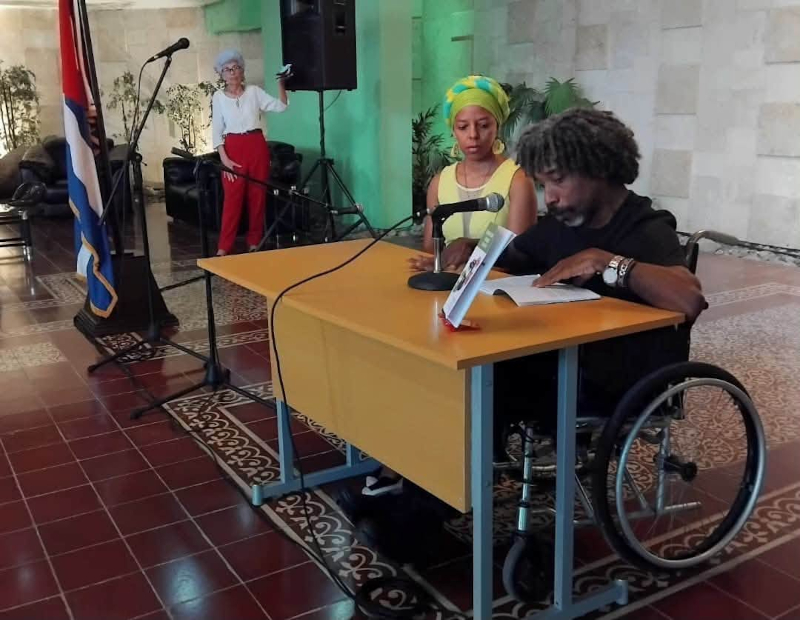
CAMAGÜEY.— On His Shoulders, the Dawn: Camagüey Poetry Dedicated to Fidel Castro brings together texts by 29 authors in a book that, beyond its commemorative purpose, documents the different ways in which a historical figure can become part of collective memory and be transformed into poetry.
Some men belong to their time. Others eventually become part of the memory of those who come after them. On August 13th, 1926, in Birán, one of those men was born—a man whose life would become intertwined with much of Cuba’s 20th-century history.
One hundred years later, in Camagüey, that enduring presence has taken a particular form: a book.
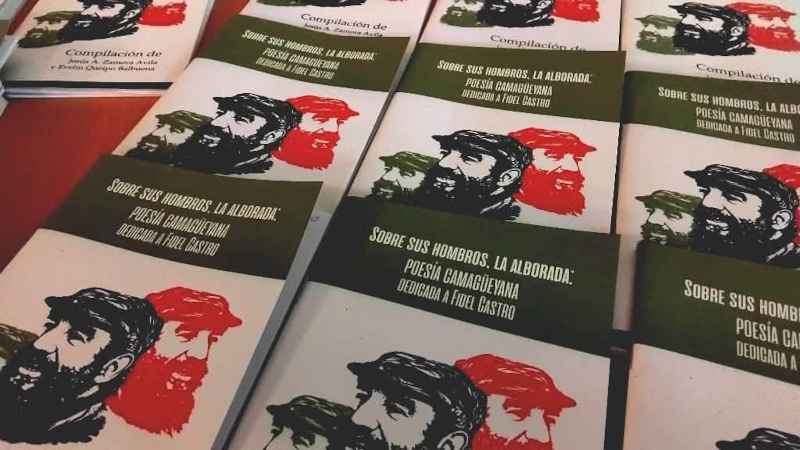
At the Nicolás Guillén Protocol Hall in Major General Ignacio Agramonte Revolution Square, On His Shoulders, the Dawn: Camagüey Poetry Dedicated to Fidel Castro was presented. The volume, compiled by Jesús A. Zamora Ávila and Evelin Queipo Balbuena, was published by Editorial Ácana in 2026.
It is neither a collection written in a single voice nor one belonging to a single generation. Its pages bring together poems by 29 authors, including established writers as well as others associated with literary organizations, workshops, and groups throughout the province. Some of the texts were written specifically for the project; others date back many years, to different circumstances, when Fidel was still alive and his presence was part of the nation’s everyday landscape.
The book also makes no attempt to conceal its commemorative nature. The edition consists of only one hundred copies and features I Am Fidel by Nazario Salazar Martínez on its cover, a digitally altered portrait based on ink on cardboard. Yet perhaps its greatest value lies precisely in what a limited edition can preserve: a record of how different people from Camagüey have viewed a historical figure and the words they found to make him their own.
“FIDEL BECAME POETRY IN MY SOUL”
The best way into the book may be the opening text, The Infinitude of the Verse That Changes Lives, by Jesús Zamora.
Zamora does not speak of an abstract closeness. He recounts how his grandmother helped Fidel during the underground struggle and in the Sierra Maestra, linking that family memory to his own story: he was born with a severe disability that barely allowed him to hold up his head, and he was able to study from home.
Then comes the child who sang, in a distorted voice but at the top of his lungs, songs that had turned Fidel into a figure in Cuban and Latin American music. He recalls Chamamé a Cuba, Eduardo Saborit, Carlos Puebla, and the Ismaelillo group. And he writes a sentence that ultimately illuminates the entire project: “Fidel became poetry in my soul.”
At the age of 12, at the Solidaridad con Panamá School, he also discovered that this transformation of Fidel into poetic material was not his alone. There he encountered verses by Che, Miguel Barnet, Nancy Morejón, and Juan Gelman. Years later, in 1996, he entered the international competition organized by the Guayasamín Foundation to mark Fidel’s 70th birthday. Among more than 4,000 works from 40 countries, he won third place in the 14-to-16 age category. At the ceremony, held at the Convention Center, he met Fidel in person.
There is, therefore, a biography that explains the compiler and, at the same time, explains the book. Here, poetry does not appear merely as an embellishment for an anniversary, but as one of the ways Zamora learned to give voice to a personal, family, and historical experience.
A BOOK OF MANY TIMES
The collection opens with Nicolás Guillén’s The Numerous Blood. It also brings together voices such as those of Luis Suardíaz Rivero and repentista Jorge L. Hernández García, known as Pompillo, alongside authors from different generations.
The title itself comes from Giant, by Edelmira Rodríguez Portal.
But one of the collection’s most revealing features lies in the dates and circumstances surrounding some of the poems. Sergio Morales explained during the presentation that his poem was written in 1980. Lino Torres, a blind poet, recalled that his was written in 2016, for Fidel’s 90th birthday: he began writing one night and continued until dawn.
Among these voices is also Léster Vargas, the youngest author in the collection, at just 16 years old.
Thus, intentionally or not, the volume becomes a kind of conversation between generations. There are those who knew Fidel personally and those who can approach him only through inherited stories, images, poems, and songs. There is the lived event, and there is the event received as memory.
Perhaps that is where one of the project’s most interesting dimensions lies.
Because turning a person into a poem does not simply mean praising them. It means incorporating them into an imaginary world, choosing which traits to preserve, which emotions to associate with them, and which metaphors to use to explain their place in one’s own life.
“ART IS A SPACE OF FULL EQUALITY”
Jesús Zamora recalled that the idea for the book originated with the Provincial Center for Books and Literature and the Provincial Directorate of Culture. Presenting the finished volume, he summed up the spirit of the initiative in a single phrase: “Today is a day to give thanks.”
He also stressed that “art is a space of full equality” and noted that poets, in their different ways, “also turned Fidel into poetry.”
The presentation made that diversity visible. Antonio Batista sang his poem. Yoandra Santa, founder of the Literary Crusade, recalled that project of the Hermanos Saíz Association, which was launched precisely in August, around Fidel’s birthday, to bring literature and music together. Alejandro González connected the occasion with another anniversary: that of the Territorial Publishing System, an initiative associated with Fidel and created to bring the books of authors from each province to their own readers.
Edelmira Rodríguez, in addition to being the author of the poem that gives the volume its title, described it as “a sincere tribute from the people of Camagüey to Fidel on his first centenary.”
Then came the improvisational poets Christian J. Muñiz and Nelson Lima.
At times, more than a book presentation, the event seemed to bring together, around its pages, part of the literary and musical memory built in the city over decades.
A CENTURY LATER
The province’s political and government authorities attended the presentation. Walter Simón, first secretary of the Communist Party of Cuba in Camagüey, received a copy on behalf of the people of the province and described it as a work of “infinite love.” In his remarks, he spoke of the Revolution, its legacy, and the need to preserve the ideas associated with Fidel.
These are words characteristic of a commemorative ceremony. But the book makes it possible to look beyond them.
Because between August 13, 1926, and this day in 2026 lie one hundred years. They encompass the childhood of a boy born into a farming family, the education of a lawyer, the armed struggle, the triumph of the Revolution, the transformations and conflicts of a nation, international confrontations, speeches, songs, images, controversies, and losses as well.
Fidel died in 2016. Yet ten years later, his figure continues to provoke words.
That does not require a single interpretation of his legacy, nor does it erase the complexities of a historical life of such magnitude. But it does say something about the persistence of symbols: when a figure is no longer physically present, another, quieter and perhaps deeper struggle begins over how that person will be remembered.
In Camagüey, this book has chosen poetry as its way of taking part in that process.
And perhaps that is why Zamora’s phrase ultimately carries more power than any slogan: Fidel became poetry for him.
One hundred years after his birth, 29 Camagüey poets chose to put him into words once again. Not all from the same place, or of the same age, or with the same experience. Some from direct memory; others from an inherited one.
The man who was born a century ago now belongs to history. The figure that each generation constructs through its memories, silences, and verses still belongs to the present.
And this small book of one hundred copies bears witness to one of those ways of remembering him.
Translated by Linet Acuña Quilez