
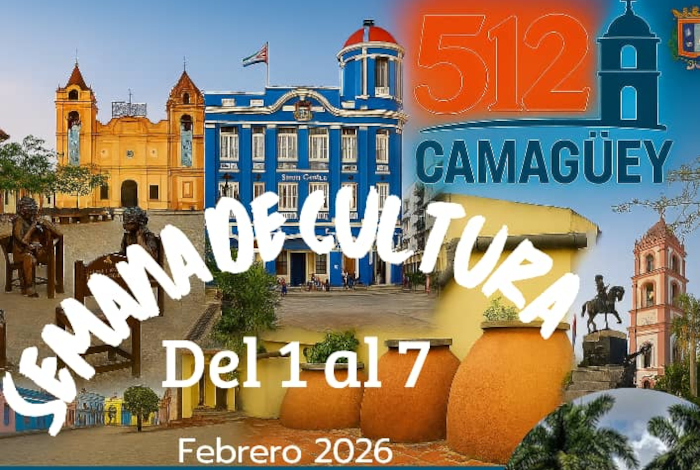
CAMAGÜEY.—Despite current economic constraints, Camagüey has decided to go ahead with its Culture Week, scheduled for February 1st–7th, as an exercise in responsibility and identity. Formats and scope have been adjusted, but the city has not renounced the core purpose of bringing together memory, artistic creation, and cultural life on the occasion of the 512th anniversary of its founding.
At a press conference, Municipal Director of Culture Daikel Guilarte explained that the program was designed to align with the territory’s current economic conditions.
“There will be no festive or dance areas. Only designated daytime spaces will be enabled at the Casino Campestre, along with the cultural corridor during its regular hours. We will also have backup power generators so that no public services are affected,” he said.
Activities are also expected to continue on Sunday, the 8th, mainly as outreach to rural communities and neighborhoods transforming. Much of the programming will rely on amateur artists’ movements and professionals from the institutional catalog.
Among the traditional offerings, the Rincón Campesino will remain in place near the Casino Campestre bandstand, under the direction of Fernando Medrano, operating Friday through Sunday from noon to 6:00 p.m.
From the Office of the City Historian, María Carmenates announced the symposium “Challenges in the Management and Governance of Cities,” scheduled for February 1st and 2nd. The event will focus on the historic urban landscape and is dedicated to scholars Lourdes Gómez and Gina Rey, recognized for their work in urban studies and heritage conservation.
Meanwhile, Luis Daniel, director of the Julio Antonio Mella Provincial Library, previewed that the Meeting of Camagüey Writers will be dedicated to the centenary of Fidel Castro’s birth, prompting the participation of writer Katiuska Blanco. Tributes will also be paid to Francisco Luna and Eduardo Torres-Cuevas.
Among the most relevant events, Bárbara Oliva, programming specialist at the Municipal Department of Culture, highlighted the Research Event, which will combine theoretical sessions—with broad participation from the Houses of Culture—and the public action “From Danzón to Rumba,” scheduled for February 5th at 2:00 p.m. at the Casino Campestre.
This year’s Culture Week will feature several special dedications: the centenary of Fidel Castro; the 90th anniversary of the Soneros de Camagüey ensemble; the 65th anniversaries of the Camagüey Symphony Orchestra and Professional Choir; the 50th anniversaries of the Jesús Suárez Gayol Museum and Circo Areíto; the 30th anniversaries of Rumbatá and the Criticism Workshop; and the 15th anniversary of the Camagua Folkloric Company.
A key institutional moment will be the Solemn Session of the Municipal Assembly of People’s Power on February 2nd at 9:00 a.m. at the Principal Theater, preceded by a performance by the Provincial Band in the small park outside the theater and followed by an artistic gala.
One of the most anticipated events is the concert by the Camagüey Symphony Orchestra and Professional Choir, featuring singer-songwriter Gerardo Alfonso, who has incorporated legends from Camagüey’s tradition into his repertoire. The concert will take place on February 7th at 8:00 p.m. in the park outside the Principal Theater, followed an hour later by the closing gala.
Beyond the artistic program, Camagüey’s Culture Week invites citizens—both residents and visitors—to rethink their relationship with the city: not only in terms of what they expect to receive, but also what they can contribute to an urban space that, amid crisis, continues to require care, memory, participation, and a sense of belonging to sustain its cultural life and heritage.
Translated by Linet Acuña Quilez