
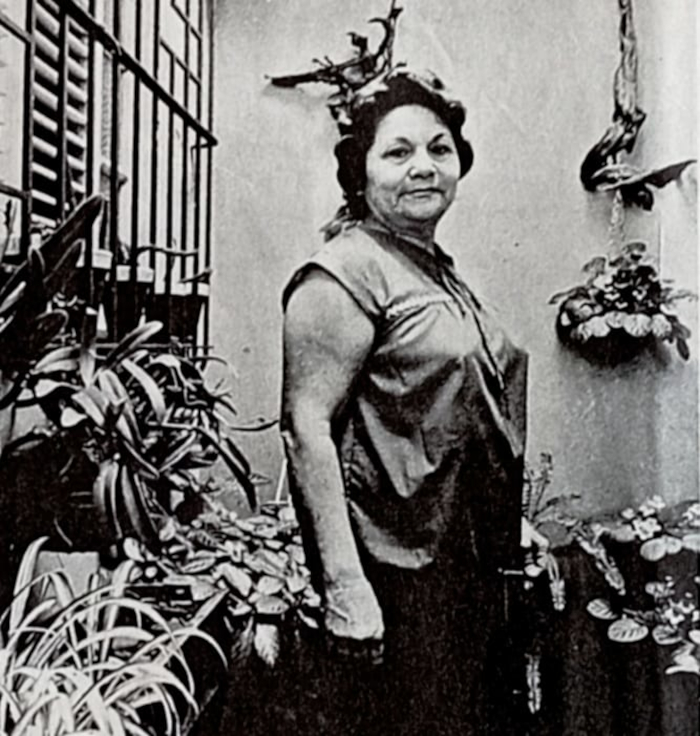
CAMAGÜEY. — Hatuey bids farewell to one of its most beloved daughters. Trinidad Cruz Crespo (Trinita), renowned artisan and cultural promoter, passed away on October 30th, 2025, at the age of 100, in Hatuey, Sibanicú. Her life was a tapestry of creativity, teaching, and love for useful beauty—one that turned her hometown into the Cradle of Camagüey Handicrafts.
The news was confirmed by painter Isnel Plana, specialist at the Municipal Directorate of Culture in Sibanicú, who emphasized that she leaves behind “a legacy of craftsmanship that went beyond local and national boundaries. A popular artisan honored with the Manos Award granted by the ACAA at the national level, she was a founding member of both the Cuban Association of Artisan Artists and the Cuban Fund for Cultural Goods. Our deepest condolences to her family and friends.”
Born on July 12th, 1925, Trinita inherited from her mother, Matilde Crespo, the talent for sewing and handmade art. From a young age, she crafted rag dolls, embroidered, wove, painted, and worked with natural materials such as jute, seashells, seeds, roots, and gourds. In the 1970s, she helped spark an artisan movement that transformed Hatuey into a cultural landmark at both the provincial and national levels.
Through her effort—and with the support of the Federation of Cuban Women (FMC) and the Committees for the Defense of the Revolution (CDR)—a workshop for local artisans was established in 1971, a space that would later become the headquarters of the Municipal Department of Culture. That collective workshop became the seed of a movement that, in 1990, earned Hatuey the official recognition as “Cradle of Handicrafts.” The title was later documented by cultural promoter Genry Torres Santana in Hatuey, Cuna de la Artesanía. Historia de una tradición (2015).
A founding member of both the ACAA and the FCBC, Trinita received numerous distinctions: the National “Manos” Award from the ACAA, the FMC Grand Prize (1971), honors at national folk art fairs, and the 25th Anniversary Medal of the MAA, among others.
Her work transcended borders. Several of her pieces were exhibited in Nicaragua, the USSR, Bulgaria, Denmark, Mexico, Finland, and Sweden, showcasing to the world the richness of Cuban craftsmanship. National magazines and publications also featured her creations.
Beyond the awards, Trinita was a teacher and mentor. In her home workshop—filled with flowers and wood—she trained generations of women who learned that crafts could transform everyday life. “What kills you is bitterness,” she used to say with firm humor, as she embroidered and planted flowers as if planting hope.
Her vitality and entrepreneurial spirit shaped an entire community. “My life has always been a spring,” she once confessed. And so it was: a century of flowers, threads, and light.
Translated by Linet Acuña Quilez