
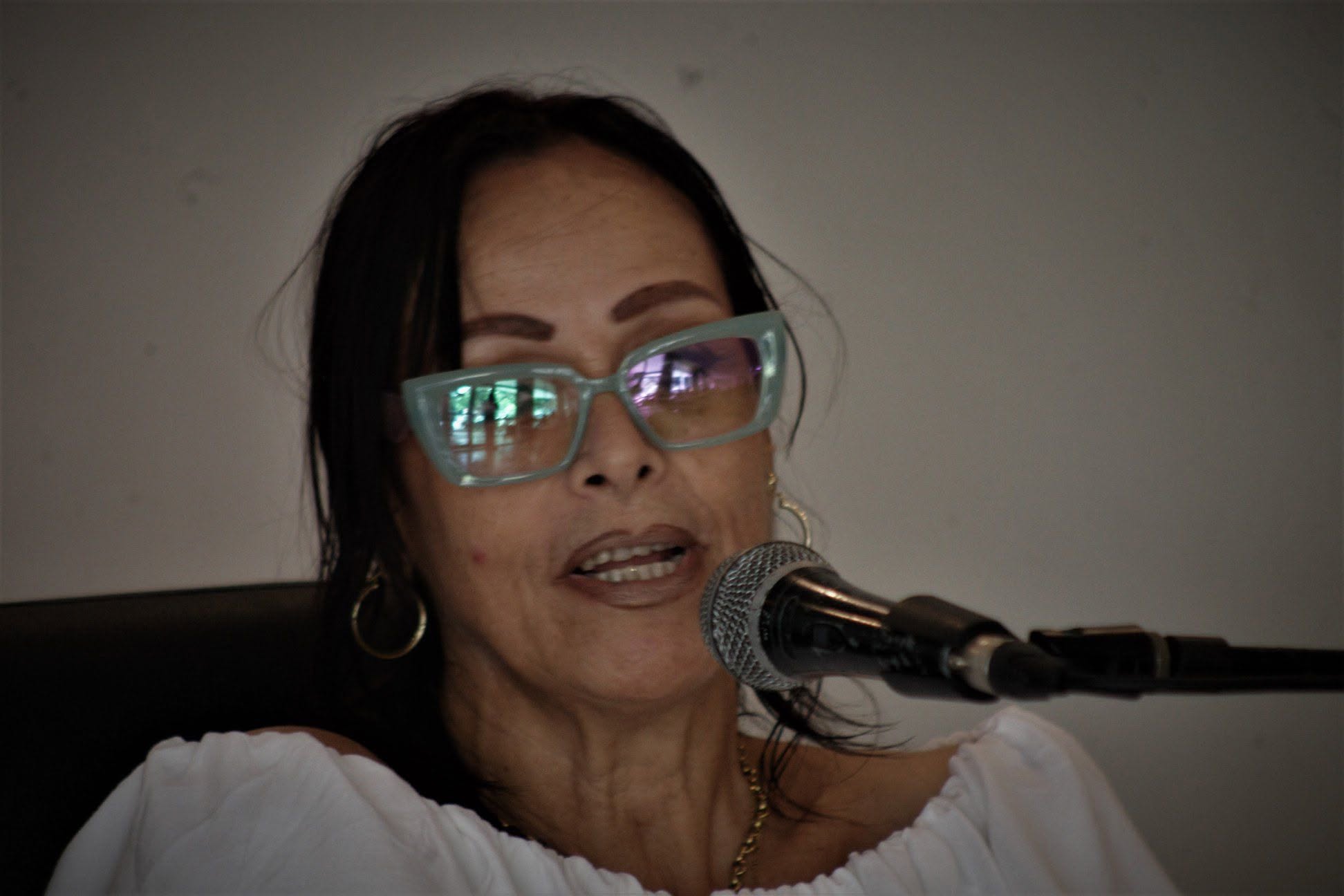
CAMAGÜEY. — The professor and researcher at the University of Camagüey came to communication by an unexpected route. She once dreamed of becoming a geologist, trained in the arts, and discovered her calling in the classroom, where she has remained devoted to teaching for decades. In this conversation, she talks about the young people who challenge her to keep learning, the communities that need to be heard, and the personal debts she feels she owes her children after trying to balance motherhood with her professional life.
Karla Gómez González is not one to give interviews. She makes that clear before the conversation begins, as though she needs to acknowledge a small departure from her usual habits. She has appeared at countless events to present research findings and share the university's experiences, including gatherings attended by prominent figures from across the country. Talking about herself, however, is less familiar territory.
The literary café La Comarca, where this meeting of Estrechando Espacio takes place, feels like a welcoming and familiar place to her. What feels less familiar is taking center stage to tell her own story. When she first received the invitation, she admits, her initial answer was no. Yet here she is, ready to talk, and as the conversation unfolds, the woman behind the professor and researcher begins to emerge.
From art and geology to communication
—Before becoming Professor Karla and Researcher Karla, what were you like? What did you imagine doing with your life?
—Sometimes coincidences are not coincidences at all. During this Cuban Culture Week, it seems fitting to remember that my first qualification was in the arts, specializing in music. I spent my childhood and part of my adolescence at an arts school.
“But my first university degree was in Geological Engineering, which I enrolled in in 1985. I saw it as connected to art and to the pursuit of knowledge.”
—Geology? Were you supposed to go to Moa?
—I spent two years in Moa. During my second year, when we had to go down into caves and mines, use mechanical lifts, and face those experiences, I realized that it wasn't what I wanted to do. So I decided to change fields.
“The first national degree program in Art Education was launched in Havana, and I took the aptitude and entrance exams and spent five years studying there. During my final year, in 1992, the instability of Cuba's Special Period forced me to complete the semester at the University of Camagüey, even though I had done all my previous training in Havana.
“Afterward, I worked as a teacher, teaching Harmony, History, and Appreciation of Philosophy and the Arts. Later, the radio station asked me to help train video library staff and production professionals, including in children's and youth programming and introductory music education.
“That connection between art and the media began opening up new possibilities. In 2001, when the Social Communication degree program was introduced as part of the universalization of higher education, I joined the program. I enrolled in the degree, and from that point on, everything I have done has been connected to communication.”
Learning from the younger generation
—After so many years in the classroom, what concerns you most about educating young people today: the way they think, conduct research, or relate to one another?
—More than worrying me, the dedication and commitment of the young people studying Journalism and Communication fill me with admiration. I admire the way they find the strength to keep improving themselves and working toward their goals, despite everything happening around them every day.
“You still find young people with strong values, a desire to contribute, respect for others, the ability to work as a team, and genuine concern for those around them. I see it in the classroom. When a student doesn't show up, their classmates don't simply make excuses for their absence; they want to know what is going on and whether that person is having problems.
“They are young people of their time, capable of analyzing, evaluating, comparing, and judging the circumstances they have had to live through. I don't criticize them for thinking that way. On the contrary, by embracing different opinions and arguments, we can support them, guide them, and offer our own perspectives without trying to force them to see the world as we do.”
—What have your students taught you? Can you remember anyone who changed the way you explain something or approach teaching?
—I have taught so many students that I think of them as my children. Every one of them has taught me something.
“I have worked with groups of twenty or thirty students, and with groups of just two. The dynamics are completely different. Every group has its own characteristics, individual personalities, and particular circumstances. Something that takes twenty minutes to work through in one classroom might take an hour in another.
“From them, I learn respect, affection, and how to recognize honesty in people. I have held management positions ever since I graduated at the age of twenty-two, but I always say that I am a teacher first and foremost. If I have classes, I won't attend a management meeting. Teaching is what I love to do. It is where I spend a large part of my life happily.
“I also learn from their music, their fashions, their concerns, what they read, and the authors they discover. Sometimes you assign independent research, and they come back with books you haven't read yourself. Then you have to stop and acknowledge that they, too, are teaching you something.
“Students challenge you, whether you like it or not. When someone who studies and works shares an experience from their own life, they can show you that what is written in books does not always fully explain what happens in reality. For me, that exchange is one of the best learning experiences there is.”
Why is communication so difficult?
—If we have so many tools for communicating today, why is it still so difficult to communicate effectively?
—There are several factors. I believe families do not always play the role they need to play. Sometimes children are simply left to find their own way, with the expectation that the school will educate them, help them develop, and provide them with every tool they need. But if the school works in one direction and the children encounter a different set of values when they get home, contradictions begin to emerge.
“Institutions also need to take greater responsibility, and schools need trained professionals who know how to work with communication tools.
“Too often, we confuse dialogue with simply answering back, participation with retaliating against an insult, and exchanging ideas with treating others the same way they have treated us. We need to learn how to communicate in order to resolve conflicts, not make them worse.
“I am glad we have a Communication Law, although I worry that everyone might interpret and apply it in their own way. We need to bring these lessons into schools and communities, where they are badly needed.
“The media also have a responsibility. A friend of mine, Roberto Pareta Bertrán, used to ask a question when we discussed these issues: What do you achieve by broadcasting a negative message throughout seventy episodes of a television series and saving the positive message for the final episode? What is the audience ultimately left with?
“Good communication means peace, tranquility, and love.”
Bringing culture into the community
—You have worked in the arts and are familiar with projects that seek to bring culture into neighborhoods. What goes wrong when a community does not feel that the cultural activities designed for it truly belong to its people?
—You don't intervene in a community. You assess its needs. What people in Belén enjoy may be completely different from what people in San Juan de Dios enjoy.
“Every place is home to people with different feelings, experiences, ways of thinking, and needs. Yet sometimes we put together a cultural program and take the same show everywhere, as though every neighborhood had the same number of children and adults, the same conditions, and the same interests.
“Sometimes the conditions needed to enjoy a performance simply aren't there. There may be technical difficulties, problems with the venue, or no suitable arrangements to allow people to stay, participate, and make the experience their own.
“We need to understand what people want to hear, what they would enjoy, and how they can take part. Why not make room for someone in the community who wants to sing, dance, or share their talent?
“Camagüey has projects that have worked to bring art closer to neighborhood communities. In my view, Golpe a Golpe has done a great deal in that regard. But we cannot assume that bringing a speaker and three performers into a neighborhood automatically means we have carried out meaningful cultural work. Culture requires participation, sensitivity, and a genuine understanding of the people it is meant to reach.”
Reclaiming the history of mobile cinema
—One of your research projects explores the history of mobile cinema in Camagüey. What led you to study that subject?
“It is part of my family heritage. My mother was director of the Cuban Institute of Cinematographic Art and Industry (ICAIC) in Camagüey for many years, and from childhood I accompanied her as she helped establish cinemas in municipalities across the province. We also visited cinemas in Ciego de Ávila and Morón. I experienced that entire process alongside her.
“When the first class of Journalism students was about to graduate, a very talented student, Liset Fundora, told me she was interested in researching cinema. I suggested that she study it not just as a cultural phenomenon but as a means of communication: its impact, the content it generated, its audiences, and its contribution to literacy at a particular point in time.
“That was how we began researching mobile cinema in Camagüey. It was wonderful to discover that the province had once had a rail-mounted mobile cinema, a boat-mounted cinema, a tractor-mounted cinema, and other vehicles that brought films to different places.
“Through photographs and interviews, we managed to reconstruct part of that experience. The research was completed in 2011, presented at academic events, and received awards. For me, it was a wonderful achievement because it helped recover a piece of history that deserved to be known.”
The difficult balance between career and family
—You are a woman who continues to learn, and you still have your doctoral dissertation defense ahead of you. What challenges have you faced in balancing professional development with family life?
—I always tried to balance my family life and my academic career, following my mother's example. She taught me that a woman should build her future on what she is capable of achieving.
“I have two wonderful children, Marcos and María Alejandra, whom I adore and consider my greatest achievement. But balancing their upbringing with my professional development has been difficult. My family is small, and I never had a reliable support system that could help me on a permanent basis. Their grandparents died when they were still young, and I had no aunts or uncles who could share those responsibilities with me.
“Today, I recognize that I owe my children a great deal because I gave priority to my professional life and, above all, to my management responsibilities. There are absences you cannot make up for once your children grow up and begin choosing their own paths.
“I remember the day of the pañoleta ceremony, when I couldn't be there because I had to be at the university; Student Day, when I had to look after my students; and all those times I couldn't take my children to the park because I had an event to attend. I would tell myself I would take them another time, but in the end, I couldn't.
“I always tried to be a caring, demanding mother and to be there as much as I could. Still, when I look back, I feel I could have done more.
“I often picked my children up from school at six or seven in the evening. One of them attended an arts school and had rehearsals to attend as well as schoolwork to complete. Once they finally fell asleep, around midnight, I would sit down to prepare classes, review dissertations, and study, with a coffee pot beside me.
“That was how I progressed through the academic ranks and completed my master's degree while preparing my doctoral research. I still have to defend my dissertation, and I am waiting for a suitable program to become available.
“At this point in my life, the degree itself does not interest me because of what it might mean for me personally or because of any financial benefit. What matters is that my research can serve the community of communication researchers and specialists. I want to leave behind work that is useful. And if I never get the chance to defend it, I would like someone to preserve it, validate it, and continue building knowledge from it.”
A message to her younger self
—If you could speak to the young woman who began teaching in the 1990s, what would you tell her about the woman you have become?
—First and foremost, I would tell her to remain the rebellious person she is. Rebellion leads to crises; crises lead to conflicts, and conflicts lead to growth.
“I would remind her that you cannot be everyone's cup of tea. When you have sound arguments, you must stand up for them. It is not about who is right, but about what the right argument is.
“I would also tell her to keep dreaming and never consider the things she wants to achieve impossible. And I would give her one piece of advice I have learned over the years: she should focus on being a mother first and then carry everything else with her.”
—What would you like your students to remember about you beyond what they find in their textbooks and course materials?
“I would like them to remember a teacher who was also a friend, someone who listened, understood, and did not judge them beforehand; someone who was open to hearing anything they needed to confess, even the things nobody else wanted to hear.
“Over the years, you always form special bonds with certain students. Some live in other provinces or abroad. When I went through an illness, former students came to my home to keep me company and spend time with me. That means a great deal to me.
“For me, communication is a way of life. I don't like making people feel bad. On the contrary, seeing someone laugh, enjoy a place, and feel good about themselves is one of the most beautiful things there is.
“I am demanding, and sometimes I can be unbearable. I argue, and I get angry, too. But those are not the qualities that define me. What I would like people to remember is the affection and trust I have tried to build with everyone who has crossed my path.”
As we say goodbye, what remains is the image of a teacher who still sees herself as a learner. The young woman who once turned away from the depths of the mines found another way to explore the world in the classroom and through communication: by discovering other people's ideas, experiences, and feelings. Her doctoral research remains unfinished, a task she hopes to pass on to others. And her words carry the understanding that not every lesson can be recorded in an academic transcript. Some come from students, others from children, and still others much later, when we look back over our own lives.
Translated by Linet Acuña Quilez