

CAMAGÜEY — The first time someone told Yemán Arias Rovirosa he was not allowed to trim his beard, he realized that a singer is also built through image.
It happened during the 2019 edition of the Adolfo Guzmán Contest, inside that television machinery where every detail — the smile, the hair, the clothes — formed part of the character that would reach the public. “Who told you you could shave?” they asked him after he slightly trimmed his beard one day. From then on, the smile stayed as a trademark, and the blond highlights became part of the visual memory that many people still associate with him.
“From now on, you always have to smile, because that’s what we’re going to sell as part of your image,” he recalls being told after one of the galas.
Yemán smiles as he tells the story. He talks about hairdressers accompanying artists to promotional events, photo shoots for every appearance, and stylists constantly watching over public image. “Havana has a different vibe — everybody’s focused on image there,” he says.
But behind that carefully built visual identity lies another, less visible story: that of a young man from Camagüey who passed through art schools, taekwondo mats, popular music groups, tourist hotels, casting calls, historical films, and asthma attacks before consolidating a solo career that now marks its tenth anniversary.
He does not exactly fit the type of singer favored by the city’s major cultural showcases. His presence has been something else: steady, warm, built without noise or spectacle. A career shaped more by perseverance than by hype.
Music entered his life long before contests, hotels, or professional stages. Yemán remembers accompanying his aunt to Campechuela as a child to follow Armando — the father of one of his late sisters — who served as musical director of the América Orchestra of Manzanillo. “I grew up surrounded by music,” he says.
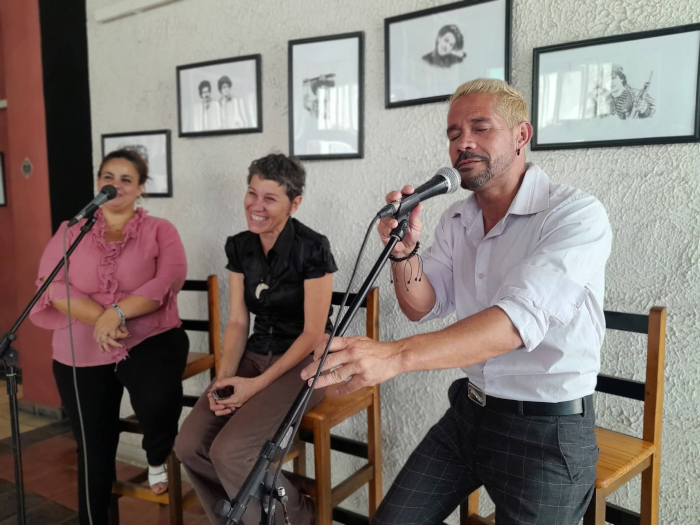
He keeps scattered images from those years: holiday trips, street festivities, musicians constantly coming and going, climbing onto stages as a child, and above all, an early fascination with the piano. “When he sat down to practice, I’d get out of bed and sit at the piano too.” There’s even a family story he hears more as legend than memory: flying in a small plane to Manzanillo when he was very young. Maybe there, among orchestras, roads, and rehearsals, everything truly began.
Before becoming a professional singer, he was an athlete. He entered the Luis Casas Romero Vocational School of Arts as a child but never finished. Later, he enrolled at Cuba’s National School for High-Performance Athletes (ESPA) and spent several years practicing taekwondo. There, he learned something that still shapes his understanding of the stage today: physical discipline.
“I was the skinniest one,” he recalls. “I was fifteen, and the others were twenty, twenty-one, twenty-two.” He also suffered from asthma.
Asthma appears again and again throughout his story — not as melodrama, but as a constant condition running quietly in the background. He speaks about it naturally, almost with the calm of someone who learned early in life to coexist with something unavoidable.
Recently, he spent nearly two months without salbutamol, the medication he has used since childhood. “I always tried to believe the illness would not defeat me.”
He explains how he learned to recognize attacks, relax, control his breathing, and avoid letting fear worsen the suffocation. He even connects it to physical training and gym culture.
“A singer, an actor, a dancer — they all have to take care of their bodies, because they work with their bodies.”
He says it's not from today’s fitness trends, but from the perspective of someone shaped by high-performance athletic training who understands that every body responds differently.
“Not everyone can handle the same load.”
After sports came another path. He studied acting at the National School of Arts (ENA) until his second year before returning to Camagüey, where he became involved in projects organized by the Asociación Hermanos Saíz, such as Pista Abierta and Golpe a Golpe, important creative spaces for a generation of young artists in the city.
His formal musical training would eventually come through a less visible institution: the School for Artistic and Cultural Development. There, he studied both popular and classical singing and trained with teachers such as Humberto García Brañas, Elio Pérez, Rodolfo, and Juan Ortiz.
“Many of us ended up at the Center for Artistic Development,” he recalls. “It was a school that also gave self-taught musicians a chance.” He speaks about the place with a mix of nostalgia and gratitude. The school disappeared in 2008.
Still, his real university was live popular music. He passed through several formats and bands: Imágenes, Latina Show, Zona 537, and Lágrimas Negras. But the turning point was Jaleo. “That was my school.”
With Jaleo, he learned improvisation, backing vocals, how to move inside Cuban popular music, and how to hold a stage night after night. Still, he quickly clarifies: “I’m not really a timba singer. I do more of a light salsa, softer timba.”
He spent nearly ten years with the group before moving to Havana in 2019 to participate in the Adolfo Guzmán Contest — an experience that changed many things.
National television made him recognizable. People began identifying him through the blond highlights, the beard, and the permanent smile. But the contest also brought him close to artists he had admired for years.
He talks about taking photos with major musicians with the same wonder of someone who still hasn’t lost the ability to be amazed. Meeting Pancho Céspedes was one of those moments. “It was a unique experience.”
He remembers the dressing rooms, the conversations, the photographs. He tells the story with the respect of someone who grew up in the provinces watching those figures from afar, only to suddenly find himself sharing space with them.
He also mentions encounters over the years with artists such as Mario Balmaseda and Alina Rodríguez.
And when he speaks about singers from Camagüey, one name emerges with particular admiration: Eduardo Cruz. “To me, he’s one of the best voices of his generation in Camagüey.” Then he adds something that seems to matter just as much to him as vocal talent: elegance. “I’ve always admired his work because he’s incredibly elegant onstage.”
In a career where Yemán constantly emphasizes image, presence, and the way an artist carries themselves before an audience, that admiration also reveals something deeply personal about his idea of artistry itself.
For a time, he thought cinema might become another path. He appeared in small television roles, teleplays, and student short films. He worked in the series Las huérfanas de la Obra Pía, in the program El cuento, and in projects created by students at the University of the Arts of Cuba (ISA).
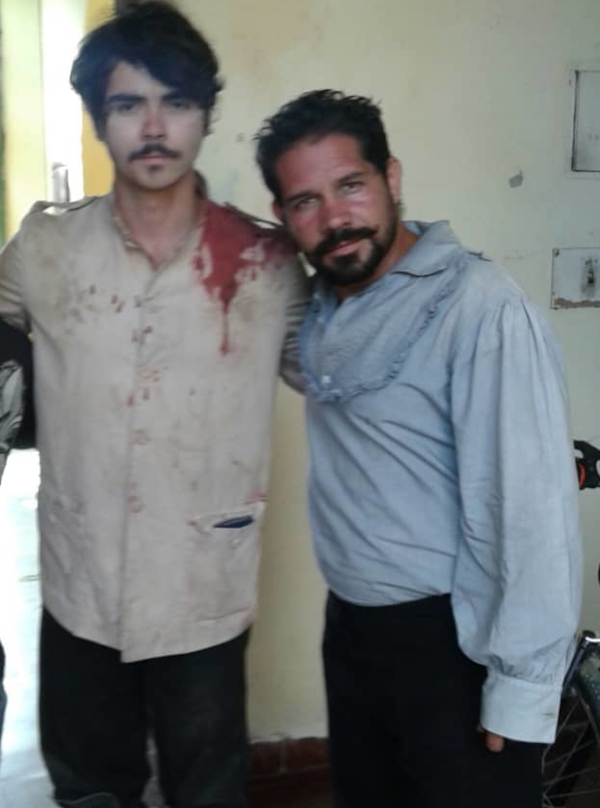
But his greatest film story came with El Mayor by Rigoberto López. Originally, he had been cast as Pancho Palomino, one of the mambí captains involved in the rescue of Julio Sanguily. To prepare, he trained in fencing, horseback riding, and stage combat. “Imagine me — I’m 1.70 meters tall — riding this enormous horse.”
He was already deep into preparation when cinematographer Ángel Alderete called him with unexpected news. Because of editing and pacing issues, several characters needed to be cut and restructured. Pancho Palomino disappeared. “They told me: now you have to play a Spaniard.”
The change happened practically overnight. Fortunately, one accidental detail helped: he had grown a huge beard. So he rebuilt himself completely to portray an older Spanish merchant who had lived on the island for years — entirely different from the mambí officer he had prepared. The role also allowed him to share scenes with fellow Camagüey actor Vladimir García from Teatro del Viento. “I transformed the character, and it worked.”
He tells the story without bitterness. In fact, he still seems amused by the absurdity of training as a revolutionary captain only to end up portraying a Spanish merchant on screen. “And still,” he says with a smile, “you’re there in the credits.”
There is another image of Yemán many people in Camagüey still remember: the dog. A Turkish kangal named Atila. “He was bigger than me,” he jokes.
People still stop him in the street to ask about the animal. Although the dog originally belonged to a cousin, Yemán eventually became almost entirely responsible for him. “He was like a little child to me.” When the dog became ill and died, he felt the loss deeply.
Maybe that’s why the story suddenly surfaces amid conversations about concerts, hotels, and performances: because it reveals another side of him — more domestic, more affectionate, less public.
Now he is preparing a concert to celebrate ten years as a solo artist. Curiously, he has never really done one before. He has sung in hotels, carnivals, galas, competitions, and countless venues, but never in a major concert entirely his own, with a live orchestra and conceived fully around his artistic identity.
“Live music has a different kind of magic.” He says it while thinking about everything backing tracks limit: fixed timing, rigid structures, the impossibility of stretching a moment when the audience responds.
Meanwhile, he continues traveling to Cuba’s tourist resorts, performing hybrid repertoires that blend salsa, ballads, boleros, pop, and English-language songs adapted into Spanish when necessary. At the Sanctuary White Sands resort in Cayo Cruz, he even created a special performance for Cuban Day celebrations: he walks onstage with a cigar and a glass of rum, beginning with traditional son music. “I’ll always work from Cuban identity.”
And when he returns to Camagüey, exhausted after overnight travel, he often ends up at La Comarca, a café he nicknamed his “command post.” There he sits wearing dark sunglasses, drinks coffee, talks with colleagues, watches cultural events, and sometimes — if exhaustion wins — falls asleep for a while beneath the air conditioning.
Perhaps that image captures him better than any other. Not the television singer with the perfect smile. Not the contestant from the Guzmán competition. Not the improvised actor playing a Spanish merchant. But an artist who has built his career through everyday endurance: staying, working, caring for his mother, living with asthma, singing wherever necessary, and still preparing — after all these years — the concert he continues to feel he owes himself.
Translated by Linet ACuña Quilez